

Cybersecurity Trends Shaping 2026
Published on: December 29, 2025
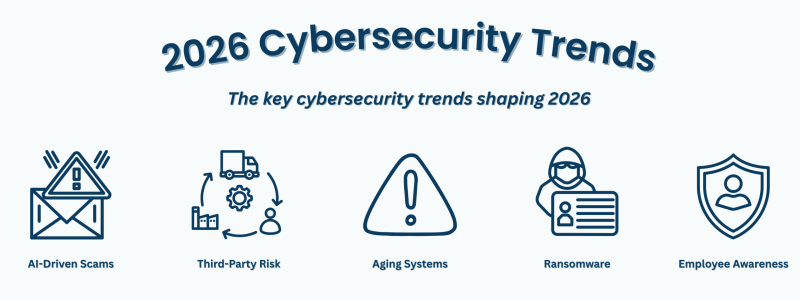
Cybersecurity continues to change each year, and 2026 is no different. New risks are taking shape as businesses rely more on cloud tools, outside vendors, and connected systems. At the same time, AI is making scams harder to spot and easier for cyber criminals to pull off. In 2026, cybersecurity trends are being shaped by AI-driven scams, ransomware, third-party risk, cloud exposure, and the need for better planning. This overview breaks down the cybersecurity trends shaping 2026 and explains what they mean in plain terms, so you can better understand the risks and take simple steps to reduce exposure.
The cybersecurity trends gaining attention in 2026 are not just IT problems. Many of them affect everyday business operations, from how employees open emails to how data moves between vendors and cloud platforms. The sections below focus on the risks that matter most to businesses this year and explain why awareness and simple planning continue to be the easiest way to prevent a cyber attack.
Cybersecurity in 2026 Requires a More Strategic Approach
Cybersecurity in 2026 is not just about responding to threats as they appear. It is about having a clear strategy that supports how your business gets work done each day. Today, most businesses use a mix of cloud platforms, outside vendors, and employee managed tools to keep work moving. This change is leading many businesses to rethink their strategy, focusing on long term stability instead of relying on quick fixes to small threats.
A strong cybersecurity strategy starts with understanding where important data lives and who has access to it. It also means knowing how systems connect, both inside the office and through outside 3rd parties. When businesses take time to plan instead of reacting after an issue occurs, they are able to stop cyber-attacks before they become a threat.
AI Is Making Scams Harder to Spot
A huge trend last year that will not be going away anytime soon is AI content. AI content has created new challenges because it is easier than ever to fake visuals, videos and sounds. Attackers are now using AI driven tools to write emails, copy writing styles, and mimic real people with ALARMING accuracy. Messages that once felt suspicious can now look routine, which makes them easier to trust at a quick glance.
These AI driven threats often rely on urgency and timing. An email may appear to come from a manager, a partner, or a known contact and ask for a fast or urgent response. In some cases, voice messages or short calls use fake messages or videos to sound convincing. This type of AI enabled social content increases the risk of employees sharing information or approving requests without confirming who is actually on the other end.
For many businesses, the biggest shift is realizing that technology alone cannot stop every attack. Awareness and simple verification habits play a role as scams become more polished. Slowing down, confirming requests through a second channel, and knowing what unusual activity looks like can help reduce risk. As AI based cyberattacks continue to evolve, managing AI risk becomes a huge part of building resilience in your organization.
Ransomware Remains the Most Disruptive Threat for Businesses
A ransomware attack happens when cyber criminals break into a system, lock access to files, and demand payment to restore them. In many cases, they also steal copies of data and threaten to release it if their demands are not met. This type of attack will continue to cause serious disruption for businesses in 2026.
The impact of ransomware often shows up immediately. Employees may lose access to important files, and systems can quickly go offline. Everyday work slows or stops, affecting customer communication, billing, and scheduling. Because so many systems are connected, a single ransomware attack can interrupt multiple parts of a business at the same time.
Preparation is the easiest way to quickly stop a ransomware attack. Regular backups, strong login protection, and clear recovery plans are just a few of the ways you can protect your business. These are just as important as knowing who to contact and how decisions will be made if an incident occurs. When businesses treat ransomware as a real risk and plan ahead, they are better positioned to recover and resume normal operations with minimal disruption.
Third Party Vendors and Cloud Tools Expand Risk
Storing data in the cloud was supposed to make life easier, and in many ways it has. Files are easier to share, systems are easier to access, and teams can work from almost anywhere on the globe. Unfortunately, there is also a downside. Data now moves through more tools, vendors, and connections than ever before, which creates more ways for attackers to access information.
Most businesses rely on outside vendors and cloud based tools to keep operations running. This includes accounting software, file sharing platforms, and other business applications. While these tools make work easier, they also mean data is constantly moving between systems and providers, which increases exposure if something goes wrong.
Attackers understand this and often look for the weakest point of entry. That weakness is not always inside your own network. A security issue at a vendor or service provider level means that hundreds of businesses valuable data could be at risk. In some cases, users or systems have more access than they truly need, which allows problems to spread faster once an attacker gets in. This is why third-party risk continues to grow in 2026.
Managing this risk starts with awareness. Businesses need to know which vendors can access their systems and what they are allowed to see or use. Limiting access, using strong login protection, two factor authentication, and keeping a short list of trusted partners can help reduce exposure. Holding physical copies of important information in a secure location can help if a vendor experiences a breach. When data is stored in more than one place and in more than one form, it is easier to regain access when systems go down. This approach gives businesses a faster path to recovery and reduces panic when an outage arises.
Why Older Systems and Delayed Updates Increase Risk
Many businesses are still running on older systems that were put in place years ago and never fully replaced or updated. In some cases, upgrades were delayed to save time or manage budgets.
Old systems are more likely to rely on outdated software or unsupported versions that no longer receive regular security updates. When patch updates are missed or delayed, weaknesses stay open longer than they should. Over time, small gaps add up and lead to big gaps making it easier for attackers to access valuable data.
Keeping systems up to date does not mean replacing your whole cyber network at once. It starts with knowing which tools are old and which ones matter most to daily work. Applying updates on time and checking systems regularly helps close security gaps before they cause problems. Take the time to update software when patches are released, even if it slows down your daily workflow. An update may slow you down today, but it could really save you from big trouble down the road.
Why Planning Still Matters in 2026
Cybersecurity planning starts with being prepared for an incident before it happens. Attacks, outages, and mistakes are part of today’s technology landscape. The difference is whether a business is prepared or caught off guard when it happens.
A clear plan helps teams know what to do when systems have been affected. It outlines who should be contacted, how communication should happen, and which systems need attention first. When these decisions are made ahead of time, businesses avoid confusion and wasted time during an incident.
Planning also makes recovery smoother. Knowing where backups are stored, how to access them, and who is responsible for key steps helps teams get back to work quicker. When expectations are set before an issue occurs, businesses are better able to limit downtime and keep operations moving.
Practical Cybersecurity Reminders for 2026
Cybersecurity does not have to be complicated to be effective. Small, consistent actions can go a long way in reducing risk and limiting disruption. As businesses plan for 2026, a few simple reminders can help keep security top of mind.
- Know where your important data lives and who has access to it, including vendors and cloud tools.
- Keep systems updated and address older software before small gaps turn into larger problems.
- Encourage employees to slow down and verify requests, especially when messages feel urgent or unexpected.
- Store backups in more than one place so data can be recovered if systems go down. Think 1 digital and 1 physical copy of your data. Learn more about the 3-2-1 backup method.
- Have a basic plan in place so teams know what to do and who to contact when an issue occurs.
Cybersecurity will continue to change throughout the year, but preparation makes a difference. If any of these topics raise questions about your technology or cybersecurity, a conversation can help bring clarity. The MMIT team is always available to talk through your current setup, explain options in plain terms, and help you decide what makes sense for your business. Many organizations rely on managed IT services in Des Moines to help monitor systems, strengthen security, and stay ahead of evolving threats.