

Why Your Cybersecurity Stack Looks Like a Stack of Swiss Cheese
Published on: October 19, 2026
At MMIT, we believe one of the most simple ways to think about cybersecurity is through something called the Swiss Cheese IT Model.
You’re probably wondering why a technology company is talking about Swiss cheese? When we talk about the Swiss Cheese Model, we are referring to the holes that can be found the layers of your IT environment.
The idea is simple: no single security tool is perfect. Firewalls have gaps, email spam filters won’t stop every phishing attempt, and employees will eventually click on a bad link.
The goal is not to find one perfect cybersecurity solution. The goal is to build multiple layers of protection so the gaps in one layer are covered by the strengths of another. That is the idea behind the Swiss Cheese Model, and it is one of the most practical ways to think about protecting a business from modern cyber threats.
What is the Swiss Cheese Model?
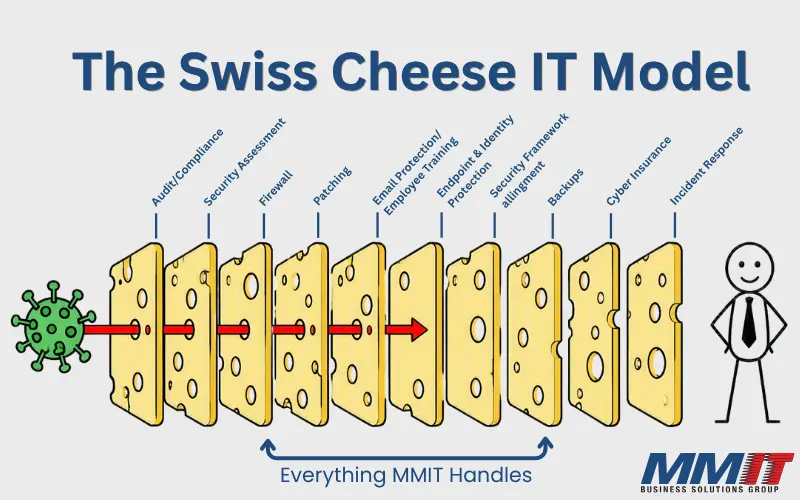
The Swiss Cheese Model is easy to understand, as pictured above. Each slice of cheese represents a layer of protection. That layer could be something as simple as employee security awareness training or as complex as cyber insurance. The holes in each slice represent weaknesses or gaps that cybercriminals can exploit to reach your business.
The more layers you stack together, the more difficult it becomes for those holes to line up. For a cyberattack to succeed, it has to make it through every layer of protection without being stopped.
Take this example for your business:
If your only defense against cyber threats is educating employees, a single mistake could allow a cybercriminal to access sensitive company information. However, when multiple layers are in place, the attack has many more obstacles to overcome.
A phishing email might first need to get past your spam filter. Then an employee would need to click the link after opening the email. They then would need to enter their credentials into a fake website. Multi-factor authentication (MFA) would need to be disabled or bypassed. Finally, endpoint detection and response tools would need to miss the activity. That is a lot of holes of Swiss cheese that need to align perfectly.
The good news is that if just one of those layers catches the threat, the attack is stopped before it can cause serious damage. That is exactly why layered cybersecurity is so effective.
Why Businesses Get Cybersecurity Wrong
Many businesses approach cybersecurity with the idea that a single slice of cheese can protect their entire business.
“We have antivirus.”
“We have backups.”
“We use Microsoft 365.”
“Our employees know better than to click on something suspicious.”
The problem is that every one of these protections has limitations. Backups help recover data after an incident, but they do not stop a phishing email from reaching an employee. A firewall can help protect your network, but it cannot prevent a stolen password from being used. Even the most alert employee can have an off day and accidentally click a malicious link.
Cybercriminals understand this. They are constantly looking for the weakest point in a business’s defenses. Often, they only need one opportunity to be successful. That is why relying on a single layer of protection is so risky. Every security tool has strengths, but every security tool also has weaknesses. The businesses that do the best job protecting themselves are the ones that build multiple layers of defense, making it significantly harder for a threat to reach valuable data or critical systems. No single slice of cheese is enough on its own. The protection comes from all the slices working together.
Where MMIT Fits into the Swiss Cheese Model
At MMIT, we’ll be the first to tell you that we are not the entire stack of Swiss cheese. No single IT provider, software platform, or security tool can completely eliminate cyber risk. Instead, we act as a technology partner that helps businesses strengthen many of the layers that make up a modern cybersecurity strategy.
Depending on your environment, those layers may include:
- Employee security awareness training
- Firewall management
- Network monitoring
- Strategic IT planning
- Identity Threat Detection & Response
- Microsoft 365 Management
These are all important slices of cheese that help reduce risk and improve your organization’s ability to detect, prevent, and recover from cyber threats.
But cybersecurity is bigger than any one vendor. Strong security also depends on factors such as multi-factor authentication, cyber insurance, internal policies, vendor security practices, and a culture where employees understand their role in protecting the business. The goal is not to build one perfect slice of cheese. The goal is to build enough layers that the holes never have a chance to line up.
In Conclusion
The Swiss Cheese Model reminds us that cybersecurity is not about finding one perfect solution. It is about building enough layers of protection that a threat cannot easily make its way through your environment.
Every business will have a different variety of slices of cheese. Some may invest more heavily in employee training, while others focus on advanced security tools, cyber insurance, or compliance requirements. The important thing is understanding that no single layer can do the job alone.
At MMIT, we help businesses strengthen many of those layers through managed IT services, cybersecurity solutions, planning, and support. Our goal is simple: help reduce the number of holes, add the right layers, and make it as difficult as possible for threats to reach your business. Because in cybersecurity, success is rarely about one perfect defense. It is about making sure the holes never line up. If you are interested in checking out how your slices line up, contact MMIT today.